Kunzea ambigua (Sm.) Druce Family: Myrtaceae
Kunzea – named for Gustav Kunze, a 19th century zoologist and botanist
ambigua – from the Latin ambiguus meaning uncertain.
Common names: Kunzea, white Kunzea, tickbush.
NOTE: This plant had previously been named by English botanist James Smith as Leptospermum ambiguum.
Overview
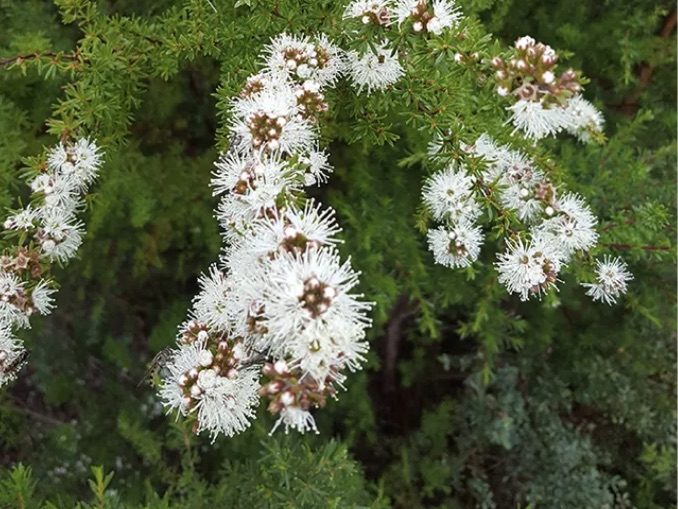
Kunzea is a medium-size aromatic shrub that is covered in white blossoms in the spring. It inhabits coastal areas south from the Hunter Valley to Tasmania, where it grows in dense thickets. Kunzea oil is a highly valued essential with multiple applications. Northern Tasmania is the center of essential oil production.
Kunzea oil is registered with the Therapeutic Goods Authority for external use only. The shrub provides shelter for wildlife; it is useful for making brush hedges and for inter-row cropping on farms.
Description
This is an upright evergreen shrub with dark, furrowed and fibrous bark, that grows to a height of 3-5m, though size is quite variable. Young stems are villous (covered in soft hairs).
Leaves grow on a short petiole (<1mm), are linear in shape, up to 12mm long and 1-2mm wide. The margins are entire.
Creamy-white staminate flowers clustered along leafy stems grow in profusion during late spring. Stamens and style are about 5mm long, extending well beyond the petals.
The urn-shaped fruiting capsules are around 3mm long.
 Indigenous Plants for Health, Inc.