Dodonaea viscosa Family: Sapindaceae
Dodonaea – named after Rembert Dodoens, a Flemish botanist of the 16th century
viscosa– from the Latin term viscosus meaning sticky
Common names: Hop bush, sticky hop bush, bururr (Wiradjuri)
Overview
This evergreen shrub has a wide distribution both in Australia and around the world. The seven sub-species found in Australia are described. The species has a history of traditional medicinal use from countries as disperse as Kenya, Mexico and India as well as Australia, ranging from treatment of wounds and stings, digestive problems, bacterial infections and diabetes.
Phytochemical analysis reveals the presence of pharmacologically active constituents such as diterpenes, triterpenoid saponins and flavonoids. Hopbushes are worthy of conserving in woodland, and cultivating in agroecological settings for their utilitarian uses which include soil binding for erosion control, hedges and windbreaks while they have ornamental value for urban environments.
Description
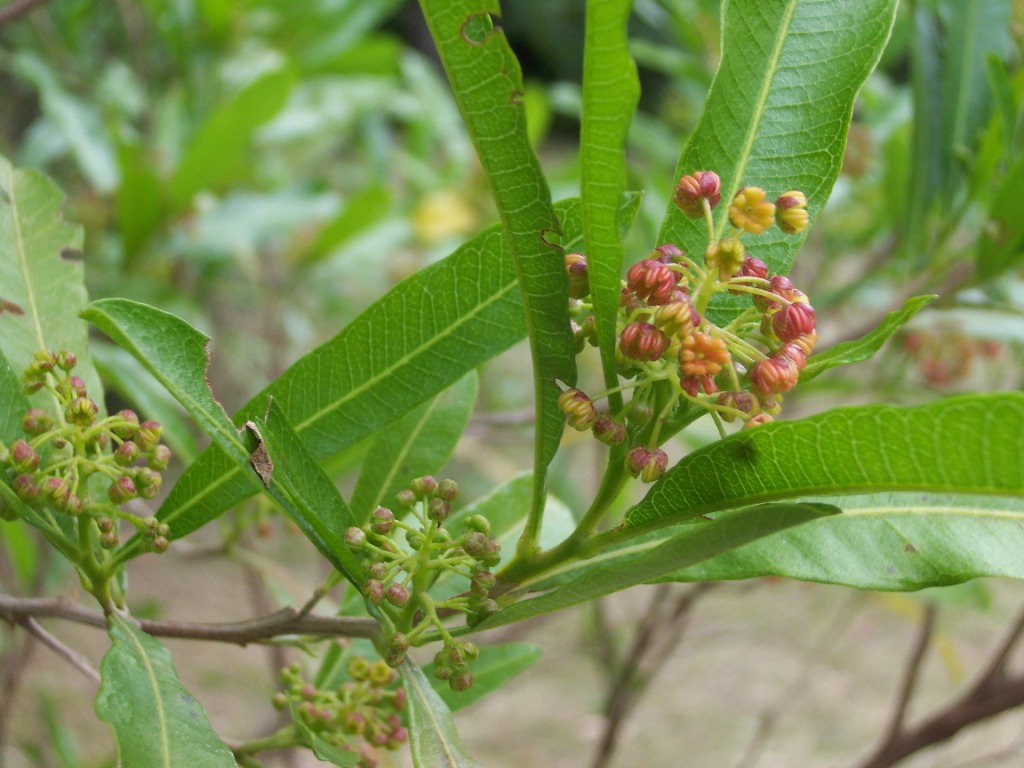
Dodonaea viscosa is an erect evergreen shrub or small tree to 8m high, which is usually dioecious ie. there are separate male and female plants. Leaves are simple, alternate, usually petiolate and glabrous (shiny surface) with a somewhat sticky texture.
D. viscosa has several subspecies, these are most easily distinguished by their leaf shape while overallheight and form may also vary. Three of the subspecies are distributed both in Australia and in other continents (Table 1). Note that subspecies arizonica is found only in Arizona, USA.
D. viscosa subsp. spatulata D. viscosa subsp. angustifolia
Flowers appear in spring, on pedicels 3-9mm long arranged in terminal panicles. There are 3-4 sepals but no petals. Ovaries are 3-4 carpellate, while the male flowers bear 6-10 (usually 8) stamens. Capsules are 3-4 –winged with a glabrous surface, appearing on the female plant during late spring into summer.
Flowers do not produce nectar, hence pollinating insects and birds are not attracted to the species. Pollen dispersal is purely via wind.
 Indigenous Plants for Health, Inc.