Our May 2026 Field Day was held at Mapleton, Queensland on Jinibara Country. It was a 2-part event, with the main Field Day on Sunday 3rd, followed on Monday by a Cyanotype Workshop on Monday 4th May (Labour Day, Qld)
With so much going on, we have two reports – from members Reesa Ryan and Pat Collins.
Reesa Ryan’s report
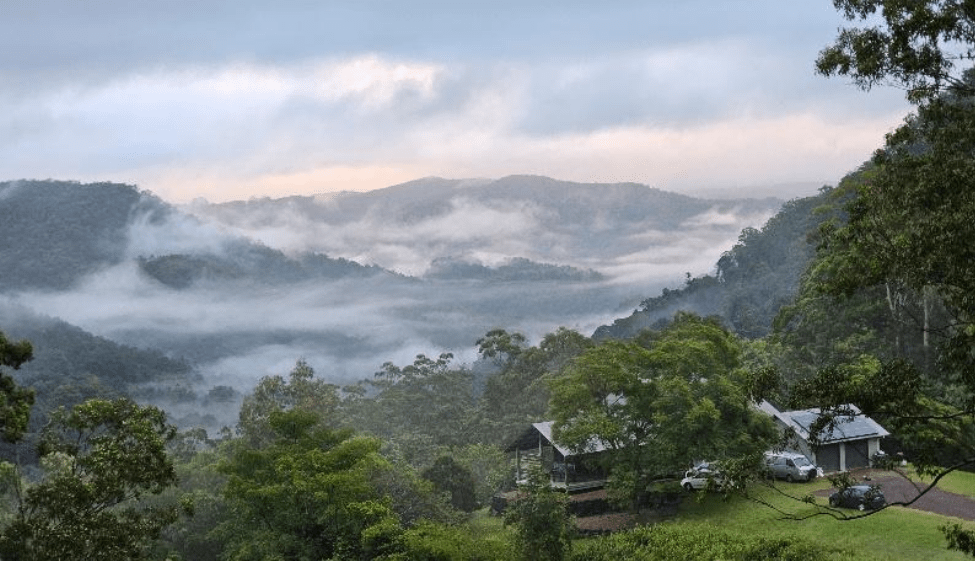
Beautiful green hills and valleys surrounded the site of the IPHA Bushfruit Field day and Cyanotype Workshop at Mapleton. The 127-acre property hosts a lovely architect designed house that is presently being caretaken by IPHA members Warwick & Mary Grace. The property had been logged, farmed and changed dramatically since colonialisation. Warwick is planting red cedars and lovingly caring for country.
To paraphrase Warwick: ‘We are all the dots … no ownership … like the reptiles and birds, we are all part of creation.”
Pat Collins was our first presenter. Pat was here with her sister Sonia and her mother Julia, who was celebrating her 93rd birthday! Pat selected a few choice plants to highlight and discuss their properties and uses.
- The Bunya (not a nut) produces a seed or fruit that is very good food, rich in carbohydrates,
while the leaf extract has medicinal properties. - Flax lily, Dianella longifolia has edible berries, when ripe. Roots and seeds used in decoction and leaves in infusion.
- Sandpaper figs are the best of the native figs for eating, while the latex can be used as a bandage.
- Geebung, Persoonia spp.—featured on the IPHA logo—is valuable for food and medicine.
Other edible fruits are derived from lilly pilly (Syzygium spp.), plum pine (Podocarpus elatus), kangaroo apple, macadamia nut, mistletoe, Tasmanian pepper, pigface, rosella and saltbush.
Finger lime (yum!) seedlings will take many years to produce. Grafted plants will give you fruit quicker. Thank you Sheryl Backhouse for the boxes of the Champaign Red finger limes for everyone to take some home.
Warwick is the caretaker of our venue, and creator of a native food forest on his property nearby. He focused on local endemic fruit and other plants like various myrtles and the native turmeric, Curcuma australasica.
There are three species of the Davidson plum, Davidsonia pruriens, D. jerseyana and D. johnsonii. Warwick grows all three. The native ginger, Alpinia caerulea, can be found along pathways the local people used. People actively and passively (eat and toss the fruit) propagated valuable plants widely.
Warwick also works with the Florabunda Community Native Nursery, a great local resource for bushcare and local native plants of this area.
Andrew continued the theme of the potential for our native ‘plum’ fruits. These local plants have far more polyphenols, vitamins and minerals that most of the exotic fruits that we eat. The various ‘plum’ species in Australia are not related to the northern hemisphere plum. The strong colour in these fruit comes from chemicals called anthocyanins, a class of water-soluble flavonoid glycosides that puts the red, blue and purple colours to many fruit and vegetables.
The Kakadu plum, Terminalia ferdinandiana, a woodland plant from the tropics has higher levels of vitamin C and polyphenols compared to other plants. Green plum, Buchanania obovata, is high in protein compared to other bush fruits, and is an excellent source of magnesium. Ooray is the traditional name, now being popularised for the ‘Davidson Plum’.
The most studied species, D. pruriens, is high in polyphenols and is a strong antioxidant. Research studies indicate the plant is beneficial for people with metabolic syndrome, a pre-diabetic condition, by lowering blood sugar and blood pressure and reducing inflammation. Anthocyanins have been proven to reduce symptoms of metabolic syndrome, type 2 Diabetes mellites as well as complications of diabetes such as leg ulcers and retinopathy.
Blueberry anthocyanins can help to reverse macular degeneration, however our native plums contain higher levels of anthocyanins. This is colour therapy in action, note other beneficial plant pigments in everyday foods—green for chlorophyll, yellow for flavonoids, orange for lycopenes.
Thank you to Jen who brought some Kakadu plum powder for us all to taste, and to Mary who demonstrated how to make the delicious Ooray cordial, which we all sampled!
Her recipe: boil up the ingredients, mash, strain. 1kg Ooray plums, 1 litre or 5 cups water, 1.5 cups sugar.
Our amazing lunch featured Bunya rissoles and kangaroo rissoles. Thank you to Pat for making them up and John for cooking them up. They were accompanied by a selection of salads and dips. Pat also made a lovely lemon myrtle cheesecake to help us all celebrate her mother Julia’s birthday.
After lunch we went for a productive weed and wild plant walk around the property.
Renata gave us an introduction to her Biochrome and cyanotype photographic artistic work: Art and science combined.
Renata works with pre-digital, analogue photographic techniques and time—but without using a camera.
Pat Collins’ report
What a fabulous field day in sunny Queensland. I usually run the field days in NSW and this time we were trying to get all of the committee to attend a field day together. I finally met our President in person and lovely to see the other members.
My mother lives in Mapleton and it was her birthday, so it was well worth the 11 hours of driving to see mum and attend the field day. What a bonus. It was also fabulous to come to such a lovely setting and when I got there was so pleased to see all the dried samples of natives, as well as plums, finger limes, macadamia nuts, books and plants to buy.
Renata also had a wonderful display of her botanic art with biochrome. Amazing lampshades, scarves and cards.
Our speakers were very knowledgeable and when I asked my mother what she remembered about the talks she said Davidson plums (Oorays) as this was a focus.
I spoke about native bush fruits and brought samples then Warwick talked about his beloved Oorays that he grows commercially and the many other plants he grows on his nearby property at Woombye.
Andrew went onto talk about the medicinal benefits of bush foods with emphasis on three native plums (Davidsonia pruriens), Illawarra plum (Podocarpus elatus) and Burdekin plum (Pleiogynium timoriense). As usual Andrew’s talk was very informative and well researched.
The morning finished with Warwick and his lovely wife Mary making us a Davidson plum cordial which was delicious.
In the afternoon we all enjoyed a walk to look at natives and weeds, and it was surprising how many we found. A focus was the lemon myrtle (Backhousia citriodora) as there was a beautiful tree at the side of the building and – unlike mine which have grown straight up – this one had a spreading nature.
Renata followed with a slide show on her botanic art with biochrome. This was a very interesting presentation and if you don’t know much about this subject she does run workshops. She ran a short one on Monday morning called Cyanotype Botanicals where you created your own unique photographic print without a camera using plants, found objects and sunlight.
The day finished with Jen our President showing some medicinal products she had made from natives mainly in the form of oxymels. We tasted many and I enjoyed the Turmeric oxymel the best.

